
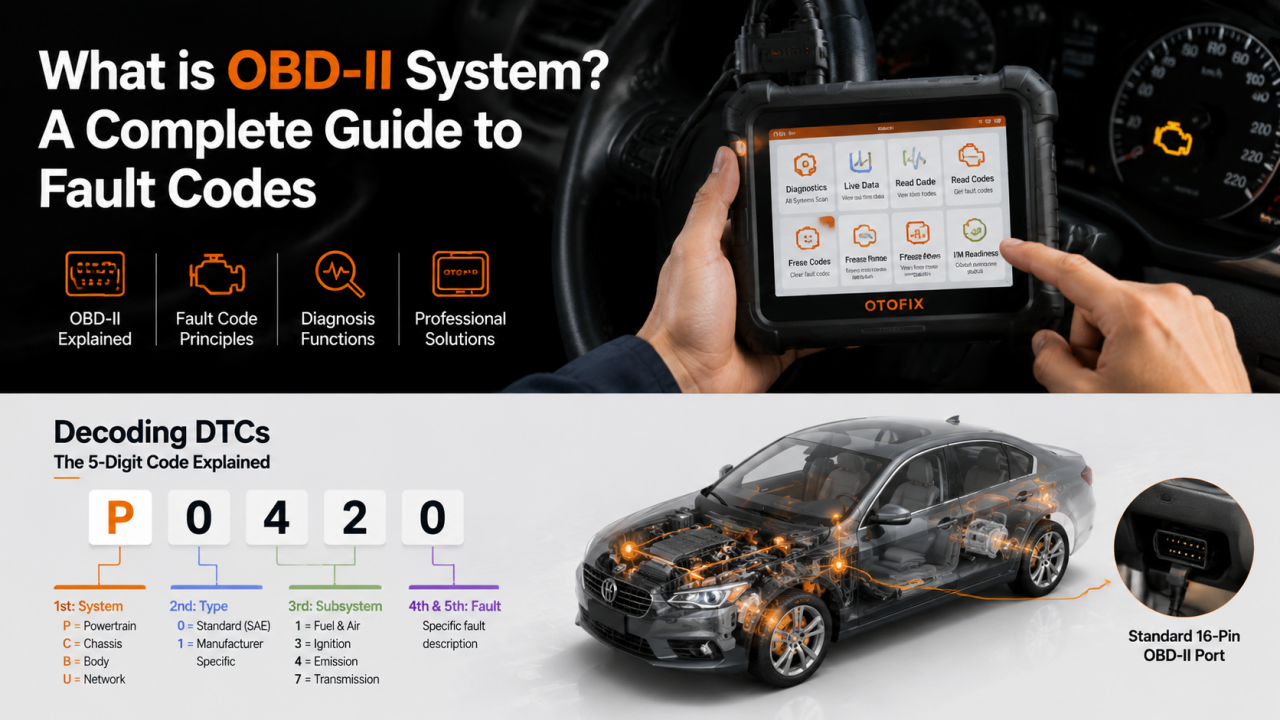
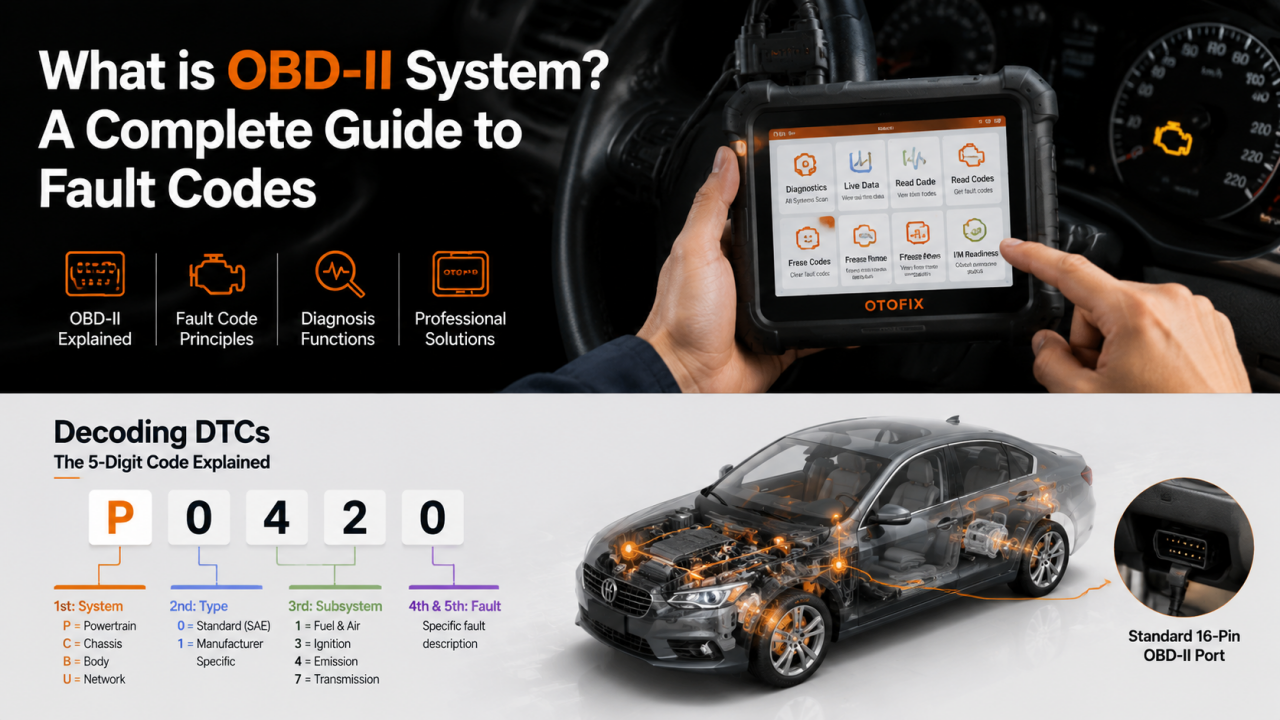
For most car owners, that little yellow engine-shaped icon on the dashboard—the Check Engine Light—is a signal of impending trouble. But for a technician, the moment that light flickers on is when the real work begins.
In this era of digital diagnostics, every secret is tucked away within a system called OBD-II. Let's decode what those mysterious Diagnostic Trouble Codes (DTCs) are actually trying to tell us.
OBD-II: The Universal "Translator" for Your Car
What is OBD-II?
OBD stands for On-Board Diagnostics. Simply put, it’s a monitoring program integrated into your vehicle's engine control unit (ECU).
Before 1996, every car manufacturer had its own proprietary system, and they rarely talked to each other (the "OBD-I" era). Since 1996, U.S. regulations have mandated that new cars sold must adopt a unified OBD-II standard. This was a significant advancement for environmental protection, and major countries soon followed suit: Europe around 2000, Japan in 2003, Korea in 2007, and China in 2008.
It was effectively a universal "language pack" and standard interface (the 16-pin port) for cars, allowing compatible diagnostic tools to interface with vehicles across the globe.
Why does the MIL light up?
The official name for that dashboard warning is the Malfunction Indicator Light (MIL).
When the OBD-II system detects an anomaly in a component (like an oxygen sensor or catalytic converter) that could cause emissions to exceed legal limits by a set margin, it triggers the yellow light.
💡 Tech Tip: If the light is steady, a fault exists but the car is usually still drivable. If the light is flashing rapidly, it typically indicates a severe engine misfire. Continuing to drive in this state can damage your catalytic converter.
Cracking the Code: The 5-Digit "Morse Code"
When a tech plugs a scanner into the OBD port, codes like P0420 or U0100 pop up. These DTCs aren't just random gibberish; each letter and number has a defined meaning.
Anatomy of a DTC (Example: P0420)
-
1st Character: Letter (System Category)
-
P (Powertrain): Engine and transmission. This is a highly common category.
-
C (Chassis): Suspension, steering, and braking/ABS.
-
B (Body): Airbags, A/C, and central locking.
-
U (Network): Communication protocols and module-to-module chatter.
-
-
2nd Character: Number (Standard Type)
-
0: Generic ISO/SAE code (defined globally).
-
1: Manufacturer-specific code (unique logic for brands like BMW or Ford).
-
-
3rd Character: Number (Subsystem Definition)
-
1: Fuel and Air Metering.
-
3: Ignition System (e.g., Misfires).
-
4: Auxiliary Emissions Controls (e.g., Catalytic Converter).
-
7: Transmission.
-
-
4th & 5th Characters: Number (Detailed Description)
-
These digits help identify the specific nature of the fault (e.g., voltage limits, open circuit, etc.).
-
What Can an OBD-II Tool Do for You?
A professional diagnostic tool doesn't just tell you what is broken—it helps you find why it broke.
-
Read Codes: Fetch current, pending, or historical fault signals.
-
Clear Codes: Turn off the warning light after a repair. (Warning: Clearing the code without fixing the car means the light will likely return.)
-
Live Data: View RPM, O2 sensor voltage, and fuel trims in real-time. It’s like an EKG for your engine.
-
Freeze Frame: Records vehicle conditions at the moment the fault occurred, helping you recreate intermittent glitches.
-
I/M Readiness: Important for smog checks. It shows whether your emissions systems are active and ready for testing. If they aren't "Ready," you may need a specific drive cycle to activate them.

Why Do You Need a Professional Scanner?
Many owners buy a basic Bluetooth dongle, but these can leave you stranded when facing complex issues. This is why the OTOFIX D1 Series is widely used by technicians and serious DIYers.
Recommended Tools: OTOFIX D1 Lite / D1 / D1 Max2
The OTOFIX D1 series effectively addresses the gap between basic retail tools and complex enterprise equipment:
-
Full System Diagnostics: It doesn't just read "P" codes. It accesses supported electronic modules (B, C, and U codes), which is necessary for addressing airbag lights or ABS faults.
-
Bi-directional Control (Active Test): This is a key capability. You can use the OTOFIX D1 to send commands—such as turning on a fuel pump or opening a sunroof—to help determine if the problem is a faulty part or a wiring issue.
The Bottom Line
The OBD-II system was a milestone in automotive history, making complex mechanical systems quantifiable. Whether you're a car owner or a pro tech, understanding the logic behind these codes can save you time in repairs and support safety on the road.
Next time your car throws a yellow light, plug in your OTOFIX device and listen to what your vehicle is communicating.